
 Amazon CEO says discovery is Apollo 11 rocket engines
- Conservator found serial number of Apollo 11 rocket engine
- Amazon CEO Jeff Bezos had sought to confirm engines were from that famous mission
- A Bezos-led team recovered the engines in March from the depths of the Atlantic
- Saturday marks the 44th anniversary of the 1969 moon landing
 (CNN) -- Amazon founder and CEO Jeff Bezos rescued
sunken treasure in the Atlantic this year: components of two F-1 rocket
engines. Now he says he has verified that they are engines from Apollo 11, the first mission that took U.S. astronauts to the moon.
(CNN) -- Amazon founder and CEO Jeff Bezos rescued
sunken treasure in the Atlantic this year: components of two F-1 rocket
engines. Now he says he has verified that they are engines from Apollo 11, the first mission that took U.S. astronauts to the moon.
The timing, as Bezos is aware, is appropriate. Saturday is the anniversary of the 1969 moon landing.
"44 years ago tomorrow
Neil Armstrong stepped onto the moon, and now we have recovered a
critical technological marvel that made it all possible," Bezos wrote on his blog.
Bezos congratulated the conservation team at the Kansas Cosmosphere and Space Center in Hutchinson, Kansas, for its efforts.
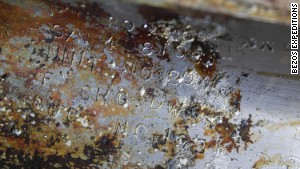
One of the conservators
discovered that the number "2044" had been stenciled in black paint on
the side of one of the massive thrust chambers. He found it while using a
black light and a special lens filter.
This 2044 was not a
mystery. According to Bezos, it corresponds to NASA number 6044, the
serial number for F-1 Engine No. 5 from the Apollo 11 mission.
The conservator continued
his work on this thrust chamber and, after removing more corrosion,
found a stamp on the metal surface that said "Unit No 2044."
"Conservation is
painstaking work that requires remarkable levels of patience and
attention to detail, and these guys have both," Bezos said of the Kansas
conservators.
Jeff Bezos said a conservator identified a serial number proving the a rocket engine came from the Apollo 11 program.
Apollo rockets recovered from ocean
An Internet retail mogul
might seem an unusual patron of Apollo 11 artifacts and history. But
Bezos said he was inspired to dream big by watching the original moon
mission as a 5-year-old in 1969.
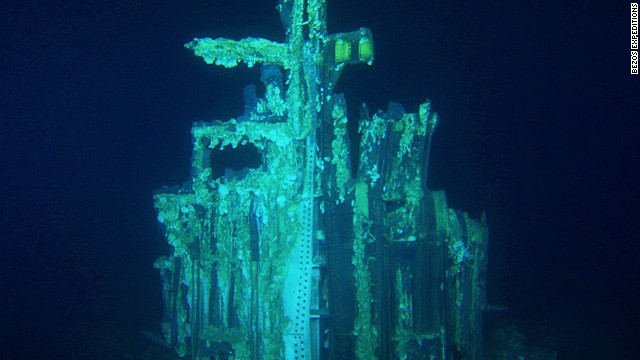
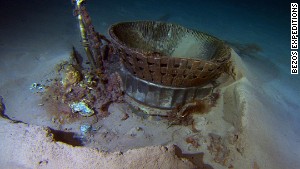
The Amazon chief announced in March
that his team of researchers had discovered a set of giant rocket
engines that he described as "an underwater wonderland -- an incredible
sculpture garden of twisted F-1 engines." They were found in 14,000 feet
of water off the Florida coast.
F-1 engines powered the Saturn V rocket
carrying Neil Armstrong, Buzz Aldrin and Michael Collins on the Apollo
11 mission to the moon. At an altitude of about 38 miles, the first
stage of the spacecraft, including the engines, separated. These parts
were considered destroyed or lost forever.
Bezos had said in 2012 that he wanted to find the Apollo 11 rocket engines but noted that many serial numbers are completely or partly missing.
"The components' fiery
end and heavy corrosion from 43 years underwater removed or covered up
most of the original serial numbers," he wrote on his blog Friday.
Each of the engines
weighs nearly 9 tons, and they came in a cluster of five. They provided
32 million horsepower by burning 6,000 pounds of fuel every second, and
together, they lifted the largest rocket in history 38 miles above the
Earth in less than three minutes.
After separation, the
rocket engines made their re-entry at 5,000 miles per hour, Bezos said,
and then plummeted into the ocean. That's where they remained,
undiscovered for decades, until Bezos' team found them using
sophisticated sonar.
"The technology used for
the recovery is in its own way as otherworldly as the Apollo technology
itself," Bezos wrote in March. "The Remotely Operated Vehicles worked
at a depth of more than 14,000 feet, tethered to our ship with fiber
optics for data and electric cables transmitting power at more than
4,000 volts."
His team felt the echoes
of the moon mission as they probed the icy depths of the ocean: "The
blackness of the horizon. The gray and colorless ocean floor."
Having taken space
venturers to the moon, the engines are now the treasure of a different
breed of explorers. Bezos said he intends to put the hardware on display
"where just maybe it will inspire something amazing."


0 comments:
Post a Comment